Enhancing Data Collection Reliability Through Improved Network Architecture
Reliable network connectivity is a critical requirement for PHANTOM® sensor data collection, and even brief interruptions in communication from a PHANTOM® Gateway 2.0 can compromise the integrity of the dataset. When links drop, measurements can be missed, reporting can be delayed, and trends can become harder to interpret–reducing confidence in analysis, system monitoring and decision-making. For this reason, VIS (Visual Inspection Systems LLC), ERBEESSD INSTRUMENTS®, and the customer partnered to identify the root cause of intermittent connectivity and implement a resilient approach that keeps data flowing consistently in a demanding industrial environment.
During joint troubleshooting between VIS, ERBESSD INSTRUMENTS®, and the customer’s maintenance and IT teams, the group observed recurring network disruptions affecting multiple gateways. Together, they traced the instability to a daisy-chained repeater arrangement in which each gateway depended on the upstream device to maintain connectivity. In practice, when an upstream gateway dropped offline, downstream devices also lost connection–creating cascading data interruptions and gaps in vibration history. The team concluded that the network lacked redundancy and that eliminating single points of failure would be essential to achieve dependable, continuous data acquisition.
Expanding Connectivity Through the Use of Wi-Fi Bridges
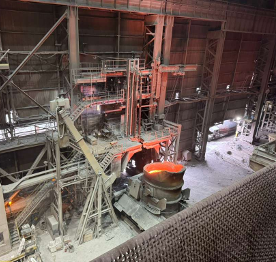
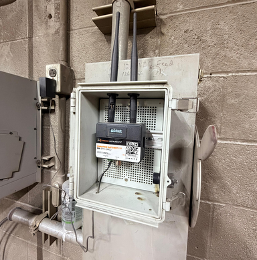
Working together in the steel mill’s challenging RF environment—where massive steel structures, dense machinery, metal shielding, and concrete walls obstruct traditional connectivity—VIS, ERBESSD INSTRUMENTS®, and the customer aligned on using a cellular modem as the primary Internet source and extending coverage with Wi‑Fi bridges. ERBESSD supported selection and configuration of Wavlink AX1800 outdoor units, while VIS and the customer coordinated placement, power, and mounting based on access and signal conditions. One AX1800 was connected directly to the cellular modem as the primary access point to the Internet.
The remaining AX1800s were configured as bridge access points, extending the network throughout the facility by relaying connectivity from the main access point—an approach the three teams validated through on-site testing and iterative adjustments to optimize coverage.
With the updated design, the gateways were connected directly to the Wavlink AX1800 bridge access points rather than being daisy-chained in a repeater hierarchy. This change—implemented and verified collaboratively by VIS, ERBESSD, and the customer—removed the cascading failures that occurred when an upstream gateway went offline, because each gateway now maintained an independent path to the network. By linking directly to the bridges and validating performance in the noisiest areas of the mill, the team achieved more stable, real-time transmission of vibration data and more complete datasets for condition monitoring
Successful Deployment and Reliable Performance
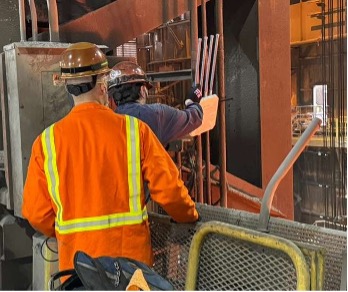
Since implementing the new network architecture, VIS and the customer have been receiving consistent, uninterrupted vibration data from all monitored areas, eliminating the gaps and delays that previously hindered analysis. The direct connections between gateways and the Wavlink AX1800 bridge access points—jointly deployed, tuned, and validated with ERBESSD—have provided stable, reliable communication so measurements are captured in real time. Building on these results, VIS, ERBESSD INSTRUMENTS®, and the customer plan to expand the architecture to additional sections of the steel mill, extending reliable data collection to more equipment and processes. This scalable approach strengthens current monitoring and supports a path toward comprehensive, facility-wide vibration analysis.