

Why One Signal Isn’t Enough — The Case for Multi-Modal Monitoring
If you’ve ever walked a plant floor and thought, “Something’s off—but I can’t prove it yet,” you already understand the core problem with single-mode monitoring.
You’re not missing experience.
You’re missing visibility.
Most condition monitoring programs still rely heavily on one primary signal—typically vibration. And don’t get me wrong, vibration is powerful. But if you’ve spent any time troubleshooting real equipment, you know one thing:
Machines don’t fail in just one way.
What should you actually be monitoring?
Let’s start with the practical question most plant managers ask:
“What conditions should I be monitoring on my machines?”
At a minimum, you’re looking at a combination of:
- Vibration: mechanical issues (imbalance, misalignment, bearing faults)
- Temperature: friction, lubrication breakdown, electrical overheating
- Motor current / power: electrical faults, load changes
- Speed / operating context: critical for interpreting everything else
- Lubrication / oil condition: wear, contamination, early-stage damage
That’s not theory—that’s straight from established condition monitoring frameworks like ISO guidance, which emphasizes using multiple parameters to assess machine health comprehensively. Because here’s the reality: Every failure mode shows up differently depending on when and how you look at it.
What's wrong with Single-Mode Monitoring?
Relying on one signal is a bit like diagnosing a patient using only body temperature.
You’ll catch some issues, but you’ll undoubtedly miss others. You may detect a fever, but will you catch the impending heart attack?
And worse yet, sometimes you’ll get it completely wrong. Afterall, you can have a heart attack without running a fever…
Peer-reviewed studies prove that combining vibration + motor current improved fault detection accuracy to 93.33%, compared to 65.56% when monitoring vibration alone and 74.44% when monitoring current alone (Kankar et al., 2011). Furthermore, combining thermal imaging + vibration reached 99.14% accuracy, significantly outperforming either method on its own (Tran et al., 2012).
That’s not a small improvement—that’s the difference between catching a failure early or explaining downtime after the fact.
If you’ve ever had to justify unexpected downtime upstream, you already know which side of that equation you want to be on.
Why does monitoring more than once condition actually matter?
Let’s translate this out of the lab and into your day-to-day:
- You Catch Problems Earlier
Different signals show issues at different stages. For example, high-frequency vibration or acoustic signals can detect early bearing damage while temperature rises often come later and electrical signatures can flag issues vibration won’t.
That extended “window to act” is what separates planned maintenance from firefighting, a distinction that matters more than most people realize.
When you’re stuck in reactive mode, the costs go far beyond the repair itself:
- Unplanned downtime hits production at the worst possible moment
- Overtime labor and emergency call-ins drive up maintenance costs
- Expedited shipping for parts adds unnecessary spend
- Secondary damage turns a small issue into a major repair
- Lost production and missed deadlines ripple across the business
In contrast, when issues are caught early through predictive monitoring, you can:
- Schedule repairs during planned downtime
- Order parts at standard cost
- Assign labor efficiently (no scrambling)
- Fix the root cause before it escalates
That shift—from reactive to planned—is where a significant portion of ROI actually comes from.
In fact, industry-backed data shows that effective predictive maintenance programs can reduce maintenance costs by 25–30% and downtime by 35–45% —largely by eliminating the chaos and inefficiency of emergency repairs.
- You Reduce False Alarms (and Alarm Fatigue)
One of the biggest silent killers of monitoring programs?
Too many bad alerts.
Multi-modal monitoring allows cross-verification. Great predictive maintenance minds know that if vibration spikes andtemperature rises, there’s likely a real issue to address; If only one changes, it’s not time to panic—it’s time to investigate.
This improves trust in the system—and makes your team more likely to act on alerts instead of ignoring them.
And in the long run, bad alarms don’t just waste time, they actively hurt operations.
When teams react to unreliable alerts, you see:
- Unnecessary shutdowns or inspections that disrupt production
- Wasted labor hours chasing issues that don’t exist
- Over-maintenance, where components are replaced too early
- Production inefficiency from constantly second-guessing equipment condition
On the flip side, you face the worst-case scenario: teams don’t react because they’ve been burned too many times. Real failures get missed, lead time disappears, and reactive mode becomes the default again. That’s the cycle a lot of plants get stuck in—and it’s not a technology problem. It’s a signal quality problem.
When alerts become more reliable, the ripple effects on production efficiency and safety are immediate:
- Fewer unnecessary stoppages
- Better confidence in when to intervene
- More uptime driven by planned decisions, not guesswork
- Maintenance teams focus on real problems
- Less time wasted chasing false positives
- Better allocation of labor and resources
- Emergency repairs = rushed decisions, higher risk
- False alarms can lead to unnecessary exposure to hazardous areas
- Missed alarms can lead to catastrophic failures
Trustworthy alerts reduce both unnecessary interventions and missed critical events
- You Actually Know What’s Wrong
Not just that something is wrong.
We all know when it comes to cost, downtime and production delays, there’s a big difference between replacing a bearing, correcting imbalance and fixing an electrical issue.
Single-mode systems often blur those lines. Multi-modal systems sharpen them.
And here’s the part that doesn’t get talked about enough: Each of those problems comes with a completely different price tag—and a completely different downtime requirement.
That’s wasted labor, wasted downtime—and frustration you don’t need.
When a fault is misdiagnosed—or only partially understood—you don’t just lose time once.
You lose it multiple times.
It often looks like this:
- Initial diagnosis (wrong or incomplete)
→ Replace a component “just to be safe” - Machine goes back online
→ Problem still exists - Second shutdown
→ More labor, more downtime, more disruption - Escalation
→ Now it’s urgent, costs increase, pressure builds
What could have been a planned, targeted fix turns into multiple maintenance events, repeated downtime windows, compounding labor and parts costs, frustration across operations and maintenance, and worst of all—loss of confidence in both the system and the process.
Not all fixes impact production the same way:
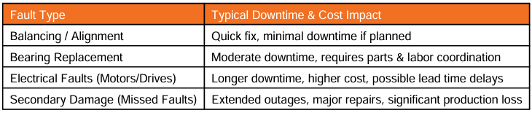
If you don’t know exactly what you’re dealing with, you can’t plan properly.
And when you can’t plan—you pay for it.
There’s another side to this too—one that looks proactive on the surface but isn’t actually efficient: Replacing parts too early because you don’t trust the data.
In many plants, this shows up as scheduled replacements based on dates instead of data and unnecessary over-maintenance to avoid risk.
It feels safe. But in reality, you’re increasing maintenance costs needlessly, introducing safety risks during avoidable interventions, and pulling resources away from real problems.
That’s not predictive maintenance. That’s controlled inefficiency.
Multi-modal monitoring sharpens the picture. Instead of guessing—or overcompensating—you make data-driven decisions.
- Is it mechanical or electrical?
- Is it early-stage or already critical?
- Is it safe to run—or time to act now?
By combining signals (vibration, temperature, current, etc.), you’re not relying on assumptions—you’re working with evidence from multiple angles.
That clearer picture leads to fewer misdiagnoses, fewer repeat repairs, more accurate planning of necessary downtime, and the confidence to act—or not—at the right time.
Where does the Erbessd ecosystem fit in?
This is where things start to click.
Multi-modal monitoring isn’t just about adding more sensors—it’s about making those signals work together.
That’s the philosophy behind the Erbessd ecosystem:
Seamlessly unite multiple condition monitoring technologies together into one cohesive, easy-to-use platform. With wireless sensors that continuously track key machine health indicators like vibration, temperature, motor current, speed, amperage, and thermography, every component is designed to capture a different piece of the asset health picture. What makes it truly powerful is how all of that data is integrated into a single workflow—one software environment where users can visualize, analyze, and act on multiple condition inputs without jumping between systems. Instead of just displaying data, the platform’s analytics help connect the dots, turning complex, multi-modal information into clear, actionable insights.
The result is a user-friendly, scalable solution that’s easy to implement and gives teams a true one-stop shop for comprehensive condition monitoring—making it easier to detect problems early, diagnose them accurately, and keep operations running efficiently.
Instead of bouncing between disconnected tools, you get a cohesive view of machine health—the way it actually behaves in the real world.
What does this mean for your plant?
If you’re exploring predictive maintenance—or trying to improve what you already have—this is the takeaway:
Single-mode monitoring answers one question.
Multi-modal monitoring tells the full story.
And that story has real operational impact.
According to U.S. Department of Energy–backed research:
25–30% reduction in maintenance costs
35–45% reduction in downtime
70–75% fewer breakdowns
Those numbers don’t come from adding one more sensor. They come from building a system that sees the machine the way it actually operates—as a combination of mechanical, electrical, and thermal behaviors working together.
Final Thought
In manufacturing, expertise is earned through real-world experience—where every decision is shaped by what you’ve seen, solved, and proven on the plant floor. We understand that reality, and it’s exactly why clarity matters.
So here’s the straight answer:
If your goal is to reduce downtime, improve efficiency, and make better decisions under pressure…
You don’t need more data.
You need the right data—working together.
And that’s exactly what multi-modal monitoring is built to deliver.
Kankar, P. K., Sharma, S. C., & Harsha, S. P. (2011). Fault diagnosis of induction motor using multi-sensor data fusion technique. Expert Systems with Applications, 38(7), 8394–8402. https://doi.org/10.1016/j.eswa.2011.01.021
Tran, V. T., Yang, B.-S., & Tan, A. C. C. (2012). Multi-sensor data fusion for fault diagnosis of rotating machinery using infrared thermography and vibration signals. Mechanical Systems and Signal Processing, 26, 72–83. https://doi.org/10.1016/j.ymssp.2011.06.010
U.S. Department of Energy. (2002). Operations & maintenance best practices: A guide to achieving operational efficiency(PNNL-13890). Pacific Northwest National Laboratory. https://www.pnnl.gov/main/publications/external/technical_reports/pnnl-13890.pdf
Megh Howard, BSc serves as the Chief Marketing Officer and Director of People & Culture at Erbessd Instruments. This unique combination allows her to unite the company’s outward-facing brand strategy with its internal culture and values—ensuring that how the company shows up for its customers is deeply rooted in how it operates from within.
Megh believes that a strong, people-centered culture is essential to delivering exceptional customer experiences. By fostering an environment where employees feel valued, connected, and empowered, she helps ensure that customer-first values aren’t just part of the marketing message—they’re lived every day across the organization. Her work aligns employee engagement with service excellence, bridging global teams and creating a workplace that mirrors the trust and support Erbessd Instruments extends to its clients and partners.
A graduate of Hudson Valley Community College and Penn State University, Megh brings a thoughtful, relationship-driven approach to leadership—connecting with colleagues, customers, distributors, and industry peers with authenticity and purpose.