
There’s something every maintenance engineer learns, sometimes the hard way: Machines almost never fail suddenly. They always give warning. The problem is that we’re not always listening. And that’s precisely where the issue of early fault detection using wireless condition monitoring sensors comes in–a strategy that no longer sounds futuristic, but rather quite practical.
One of the most commonly used methods is vibration analysis. This technique makes it possible to identify mechanical failures before they cause unscheduled downtime. Here we show you an example based on the case presented by the Engineer Luis Canales Rocha from Erbessd Instruments at the 25th Peruvian Congress of Maintenance Engineering and Reliability.
Vibration Analysis in CNC Spindle Bearings
In this case, vibration analysis was applied to a bearing in a CNC spindle and the following were identified: the failure frequencies of each of its components. These include the inner race, the outer race, the cage, and the rolling element. Each component has a specific vibration signature. When damage occurs, that signature becomes visible in the spectrum. In the case analyzed, the most significant damage is present in the rolling element. This is seen clearly in the following image.
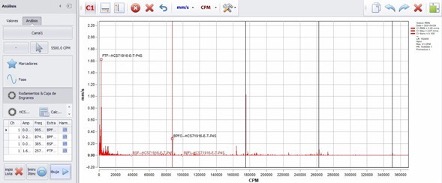
This damage is not only detected but the characteristic frequency. Harmonics associated with that frequency are also observed. This indicates that the failure is already severe and that the bearing deterioration is at an advanced stage. This type of information allows you to confirm the actual condition of the component without disassembling it. And that saves time.
Identification of Mechanical Clearance in the Housing
Another analysis presented concerns an electric motor. In this case, the measurement point is located on the bearing housing cover. Vibration analysis shows the existence of Mechanical play between the outer race of the bearing and its housing in the motor. This condition generates repetitive impacts that are clearly recorded in the signal.
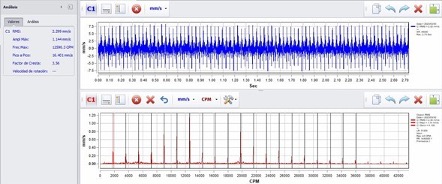
Looseness isn’t always detectable through visual inspection, but it becomes clear in vibrations when the signal is analyzed correctly. This condition affects the mechanical stability of the assembly and can accelerate bearing wear.
Stop test for further analysis
In this study, a shutdown test was performed, as it is a useful tool for understanding the origin of certain vibrations. In the first stage, the motor is energized. During this condition, a vibration associated with the rotational speed is observed.
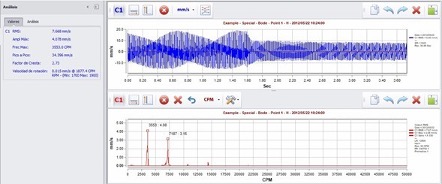
In addition, an extra vibration is present. This vibration does not directly correspond to a typical mechanical failure. For this reason, it is suggested the it could be electrical noise. To verify this, the motor’s power is disconnected. When this is done, the vibration attributed to electrical noise disappears. Only the vibration related to the shaft’s rotational speed remains.
This result confirms that the additional vibration is not of mechanical origin. The test clearly distinguishes between the two effects and prevents incorrect diagnoses.
Use of condition monitoring in diagnosis
The cases analyzed show how condition monitoring identifies different types of failures. Severe damage to rolling elements, mechanical play in housings, the presence of vibrations associated with electrical noise.
The use of wireless sensors makes data collection easier. But the real value lies in the analysis. Measurement alone solves nothing if it isn’t interpreted correctly. When condition monitoring is applied consistently, it becomes a robust tool for supporting equipment reliability. It allows for data-driven decision-making and understanding machine behavior before failure becomes apparent. And in maintenance, it makes all the difference.
About the Author
Luis Canales, Sales Agent at ERBESSD INSTRUMENTS®️, has 10 years of experience within the company, establishing himself as a technical and commercial reference in the industrial sector. He specializes in predictive maintenance, vibration analysis, and on-site dynamic balancing, areas in which he has supported various industries in optimizing the reliability and performance of their assets.
Throughout his career, he has delivered technical training to clients, sharing practical and strategic knowledge for the proper implementation of condition-based maintenance programs. In addition, he is a specialist in Industry 4.0, promoting the integration of intelligent technologies and innovative solutions for the digitalization and modernization of industrial processes. His approach combines technical expertise, close customer engagement, and a results-oriented vision.
ERBESSD INSTRUMENTS® is a global manufacturer of Vibration Analysis Equipment, Dynamic Balancing Machines, and Condition Monitoring solutions, with facilities in Mexico, United States, UK, Colombia and India.