
Better Together: How Route Collection and Online Monitoring Helped Prevent a Paper Mill Shutdown
A Familiar Problem Returns
Using routine route collection data, we identified a concerning trend: a replacement press roll installed only a month earlier was beginning to show the same failure indicators as the roll it had replaced. The trend suggested the replacement roll could fail before the original roll was repaired and returned to service.
Impacts at running speed, accompanied by harmonic activity and sideband patterns around the roll speed, suggested the machine was beginning to exhibit the same behavior that preceded the earlier failure. While the issue was not evident during previous inspections, a route collected on February 6 revealed a noticeable change in condition, prompting immediate concern that the replacement roll might not survive long enough for the original roll to be repaired and returned to service.
The route data successfully identified the problem. What it could not determine was how quickly the condition was progressing–or how the roll was responding to changing the process conditions throughout the day.
From Periodic Snapshots to Continuous Insight
The following day, the maintenance supervisor asked whether the existing PHANTOM® Online system could be moved to the at-risk roll. Because the facility was already utilizing ERBESSD’s ecosystem, a spare Gateway and PHANTOM® sensors were deployed and collecting data. What had traditionally been a route-monitored asset instantly became an online-monitored asset without requiring new software, separate databases, or a permanent installation.
On February 8, the team began seeing something unexpected.
Instead of steadily increasing, vibration amplitudes were fluctuating dramatically throughout the day. In some cases, acceleration levels changed by more than 70% over relatively short periods of time. The roll would alternate between periods of elevated impacts and periods of reduced severity, making the true condition difficult to understand through periodic route measurements alone.
One of the most valuable discoveries was that the roll’s condition was not static.
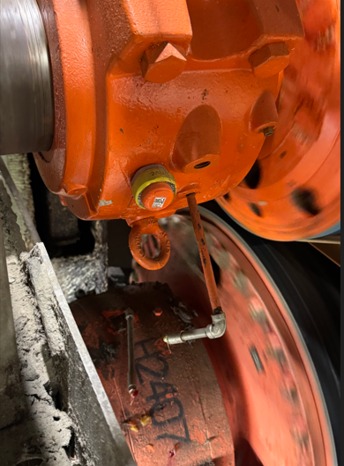
On several occasions, the PHANTOM® system captured sudden increases in impact activity and vibration severity that would have been impossible to observe through a monthly route. In one instance, vibration levels increased by more than 700% compared to historic baseline values. Yet at other times, the severity appeared to decrease significantly depending on operating conditions.
This variability explained why diagnosing the issue had been so challenging. A route collected during a “good” operating period could underestimate the severity of the problem, while a route collected during a “bad” period might suggest imminent failure.
Continuous monitoring revealed a pattern: many of these changes coincided with production variables such as grade changes, machine speed adjustments, and vacuum loading conditions. Operators had long suspected that process conditions were influencing the roll’s behavior. The online data finally provided evidence to support that theory.
The data also helped isolate where the issue was most severe. Measurements collected from the trending-side bearing consistently showed significantly higher amplitudes than those collected on the drive side, while gearbox measurements remained relatively stable. This allowed the team to focus attention on the roll itself rather than pursuing unnecessary corrective actions elsewhere in the drive train.
Continuous monitoring eliminated the guesswork by providing a complete picture of how the asset behaved over time.
Route Monitoring and Online Monitoring: Better Together
A common misconception is that online monitoring replaces route collection. This project demonstrated the opposite. Route monitoring identified the issue, while online monitoring provided the continuous visibility needed to understand it. Because route and online measurements shared the same EI Analytic™ database, we could immediately compare new online measurements with months and even years of historical route data. There is no need to merge datasets, switch software platforms, or rebuild asset histories. The customer gained continuous monitoring while maintaining the context and trends already established through their route program.
The Bigger Lesson
Every facility is on a different reliability journey. The most effective solutions are not those that force customers into a single approach, but those that provide flexibility. This case study demonstrates how ERBESSD’s integrated ecosystem allows reliability teams to respond quickly, gain deeper insight, and make better decisions before failures impact production.
About the Author
Robert E. Hunt is President of Vibration Integrated Technology Services Ltd., founded in 2003, and an authorized ERBESSD INSTRUMENTS® distributor since 2022. He brings over 30 years of millwright experience and 25 years in vibration analysis across industries including paper, cement, food and beverage, rubber, and water treatment.
A Red Seal Interprovincial Millwright and certified Level 3 Vibration Analyst, Robert published technical papers with the CMVA and is committed to developing the next generation of reliability professionals, having trained multiple analysts and apprenticed millwrights.