
WaaS / SaaS Wireless Sensor Discussion
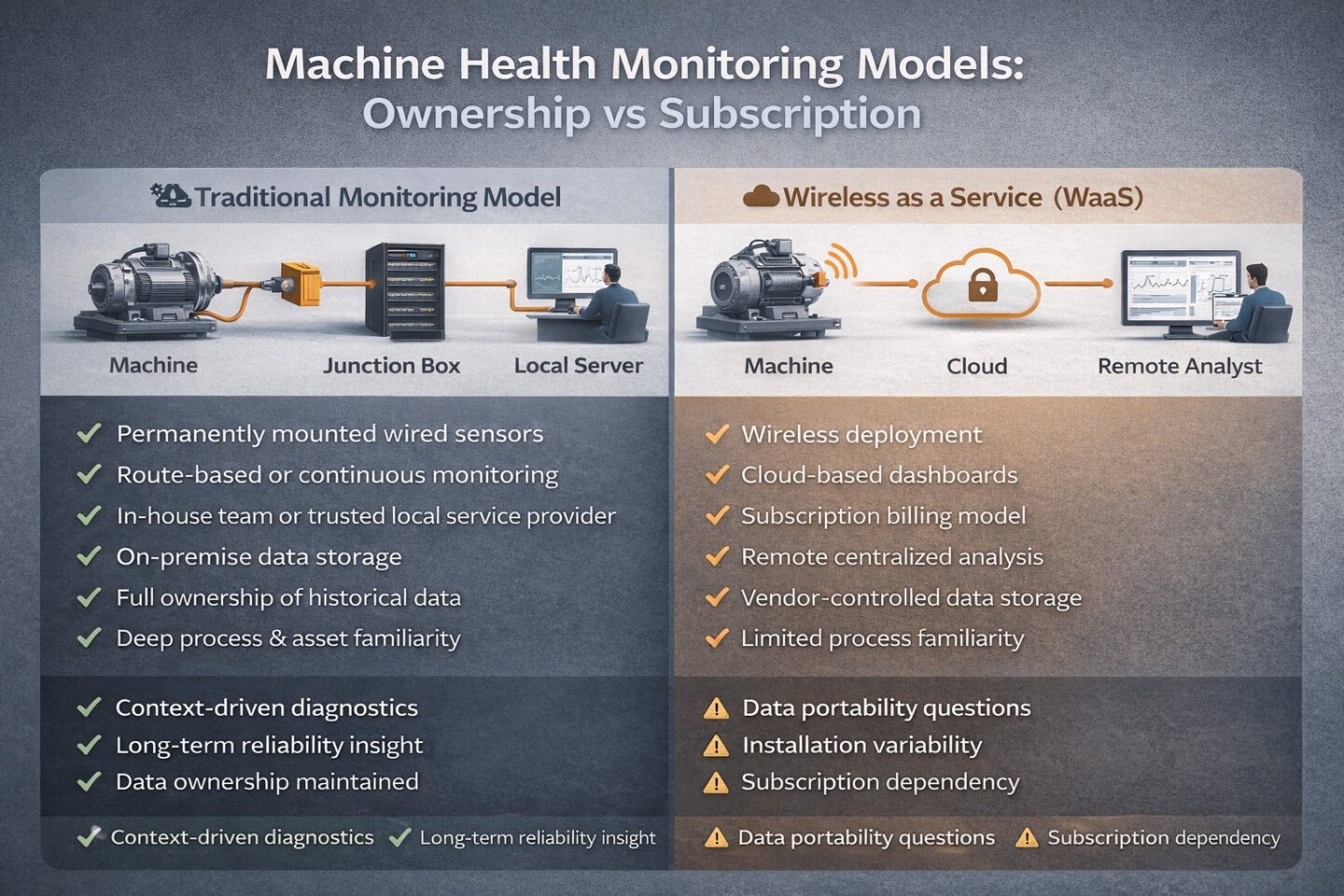
For decades, vibration analysis and machine health analysis has followed a proven and effective model. Sensors were permanently mounted, wired to junction boxes, and data was collected either continuously or through route-based periodic inspections based on asset criticality. These programs were managed internally or through third-party vibration service providers who specialized in machine health, reliability, and diagnostics. Many of these providers including many that I have the pleasure of working with have developed a deep, long-term familiarity with specific facilities, machines, and processes.
The introduction of wireless accelerometers and other sensing modalities (such as those developed within the Phantom® family of products) changed how data could be collected. By eliminating cable and reducing infrastructure requirements, wireless sensors offered flexibility and faster deployment. Instead of walking routes with a handheld data collector, engineers could access vibration data remotely and more frequently. While wired systems like Defiant™, continue remain essential for high-bandwidth or continuous monitoring applications, wireless technology created a practical balance between data accessibility and collection frequency.
More recently, many wireless sensor manufacturers have shifted to Wireless as a Service (WaaS) or Software as a Service (SaaS) business models. These offerings bundle sensors, software cloud storage, and remote analysis into subscription-based “complete monitoring solutions.” While this model provides predictable recurring revenue for manufacturers, it fundamentally changes how machine health monitoring is delivered–and not always to the customer’s benefit.
This shift has also displaced many traditional vibration service companies–organizations that have monitored the same machines for years or even decades–in favor of remote, generalized monitoring platforms that lack deep asset or process familiarity.
Why WaaS Might Be Attractive
- More frequent data collection (often daily instead of periodic routes)
- Broader coverage by deploying more sensors across more assets, wirelessly
- A single vendor responsible for installation, data collection, analysis, and reporting
- Cloud-based dashboards accessible from anywhere
- Reduced on-site workload for maintenance teams
At first glance, these offerings appear modern, efficient, and comprehensive. However, these perceived advantages often obscure significant technical, operational, and cybersecurity limitations that only become apparent over time.
The Limitations of WaaS / SaaS Models
More Data Does Not Mean Better Decisions
High-frequency data collection often results in excessive alerts for minor or insignificant changes. This can lead to alarm fatigue, where maintenance teams become desensitized to alerts and risk overlooking genuinely critical conditions. More data without context does not improve reliability–it often complicates it.
Installation Quality is Inconsistent
Accurate vibration analysis begins with proper sensor installation. Experienced service providers understand correct mounting methods, surface preparation, sensor orientation, and structural considerations. WaaS installations are frequently performed by general installers with limited vibration expertise, resulting in poorly mounted sensors and unreliable data. Collecting inaccurate data more frequently does not improve diagnostic confidence.
Lack of Machine and Process Understanding
Machines do not operate in isolation. Even identical assets can behave very differently depending on process conditions, load profiles, maintenance history, and operating environment.
For example, a Goulds 3196 pump–one of the most common centrifugal pumps in industry–will behave differently in Fort Edward, NY than the same model operating under similar nominal conditions in Macon, Georgia. Subtle process and environmental differences significantly influence machine health indicators.
Local service providers and in-house teams build contextual knowledge through years of direct, hands-on experience. Remote analysts working from generalized dashboards lack this operational insight, which limits diagnostic accuracy and increases the likelihood of misinterpretation.
Hidden Long-Term Costs
Many wireless OEMs deploy sensors at little or no cost during trial periods. However, subscription fees, sensor replacement, battery maintenance, data access fees, and long-term contractual obligations often emerge after the trial ends. These costs should be fully understood before committing to a WaaS model.
Sensor Performance Varies in Real-World Conditions
Sensor specifications may appear comparable on paper, but real-world performance–including bandwidth, noise floor, repeatability, and mounting sensitivity–can differ significantly. Without independent validation, users may rely on data that lacks the fidelity required for meaningful diagnostics.
Data Ownership and Portability Risks
In many WaaS models, vibration data is processed and stored in vendor-controlled cloud environments. Critical questions must be addressed:
- Who owns the data–the OEM or the end user?
- Can historical data be exported if the contract ends?
- Is the data available in industry-standard formats such as UFF58, ASCII, or CSV?
- Is the database schema accessible to support future migration?
As noted by Maayan (2024), “Data may be generated by devices owned by users, but processed and stored by service providers which may lead to a complete lack of portability of data.” Loss of historical machine health data severely limits trend analysis, fault progression tracking, and long-term reliability improvement efforts.
Cybersecurity and IT Constraints
Cybersecurity is an increasingly critical–and often underestimated–factor when evaluating WaaS and SaaS based condition monitoring solutions. Because most WaaS platforms rely on cloud-based data storage and remote access, they introduce cybersecurity and IT risks that must be carefully evaluated before deployment.
Cloud-based monitoring solutions should be throughly vetted by internal IT and cybersecurity teams. Key questions include:
- Is the provider FIPS 140-2 compliant, ensuring cryptographic modules meet recognized security standards?
- Are the providers’s servers or server farms secure and ISO/IEC 27001 certified, demonstrating a formal information security management system?
- Is data encrypted, using industry-accepted encryption standards?
- What authentication methods are used? Does the system support two-factor authentication (TFA), role-based access control (RBAC), full administrative control by the physical process/machine owner?
- How is network access managed, and does the solution require outbound internet connectivity that may violate existing IT or OT security policies?
Even in less regulated industries, introducing unmanaged cloud connections can create new attack surfaces. Once machine health data leaves the facility, the end user must trust that it is protected to the same standard as other mission-critical operational data.
Making the Right Decision
Selecting the right machine health strategy ultimately depends on three key factors:
- Budget – Are long-term subscription costs sustainable, or does owning hardware and data provide better long-term value?
- Personnel – Do you have qualified internal staff, or can you partner with a trusted local service provider who has a deep understanding of your equipment and process?
- Trust – Can you rely on remote analyst–who have never seen your machines or operated within your process environment–to make accurate diagnostic decisions? Can you trust them to install sensors correctly, secure your data, and align with your IT policies?
For many facilities, the most effective approach remains maintaining internal ownership or partnering with an experienced local service provider–one who understands not just machinery health and vibration data, but the machines, the process, and the operational realities behind the data. Technology should enhance expertise, not replace it.
Brad Ferraro, BBA, ISO CAT-1 VA, is the Customer Success Leader at ERBESSD INSTRUMENTS, based in New York. In this role, hem manages customer relationships to ensure smooth program implementations and long-term customer satisfaction. Brad is actively engaged with clients year-round, representing ERBESSD at industry conferences and conducting on-site visits to support customer needs.
With over seven years of experience in the vibration and condition monitoring industry, Brad has worked with several leading sensor manufacturers across both wired and wireless technologies. He studied Business Administration and holds Category I Vibration Analyst certification.
ERBESSD INSTRUMENTS® is a global manufacturer of Vibration Analysis Equipment, Dynamic Balancing Machines, and Condition Monitoring solutions, with facilities in Mexico, United States, UK, Colombia, and India.