AI does not replace the expert: it gives them superpowers. Specialists have their place in this world, and far beyond what we imagine.
A few days ago I saw something that, quite literally, blew my mind.
I was watching Ken Starry, an ASNT PdM Level III certified vibration analyst, work with Erby, the artificial intelligence agent that lives inside EI-Analytic™.
He wasn’t asking it for reports. He wasn’t asking whether a machine was vibrating “a lot or a little.”
He was shaping the tool. Prompt after prompt, guided only by his experience and his way of looking at data, Ken started building things that would normally have taken an entire development team. Mine.
And suddenly, there it was on the screen: a Japanese candlestick chart, like the ones from the financial markets, applied to vibration trends.
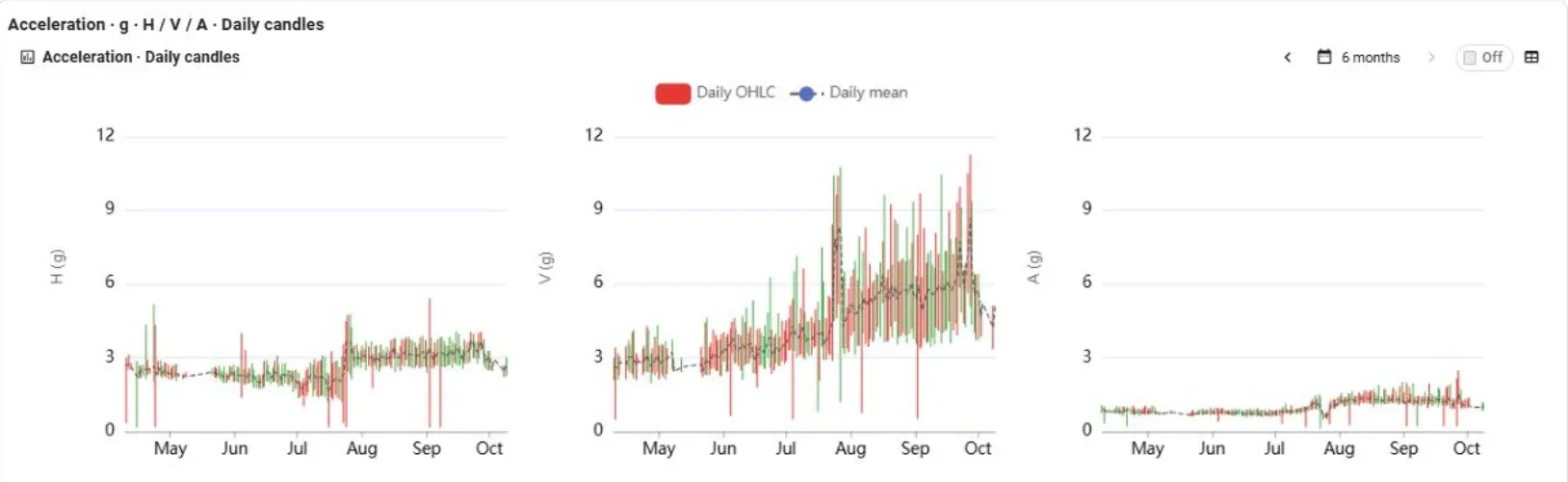
The high, the low, the direction of change and the average of each day. Six months of a machine’s behavior, read at a glance. And with a detail that still makes me smile: on the stock market, green means the price went up. On Ken’s chart, green means the vibration went down, because in our world, up is bad.
I have spent years looking at trend charts. I had never seen anything like it in machinery analysis. And it would never have occurred to me.
How an idea nobody had before gets built
It is worth seeing how it started, because it wasn’t a flash of inspiration: it was an instruction. Ken wrote to Erby what he wanted to see, with the precision of someone who has spent decades looking at this data. A candlestick chart for the point selected in the tree: velocity, the last three months, running readings only. Daily candles plus a seven-day moving average. If the point has alarm levels, the alert and danger thresholds as dashed lines. Y axis from zero, light background, big fonts. Days when vibration goes up in red; days when it goes down in green. And he closed with the reason: “I want to see at a glance how fast this machine is approaching its limits.”
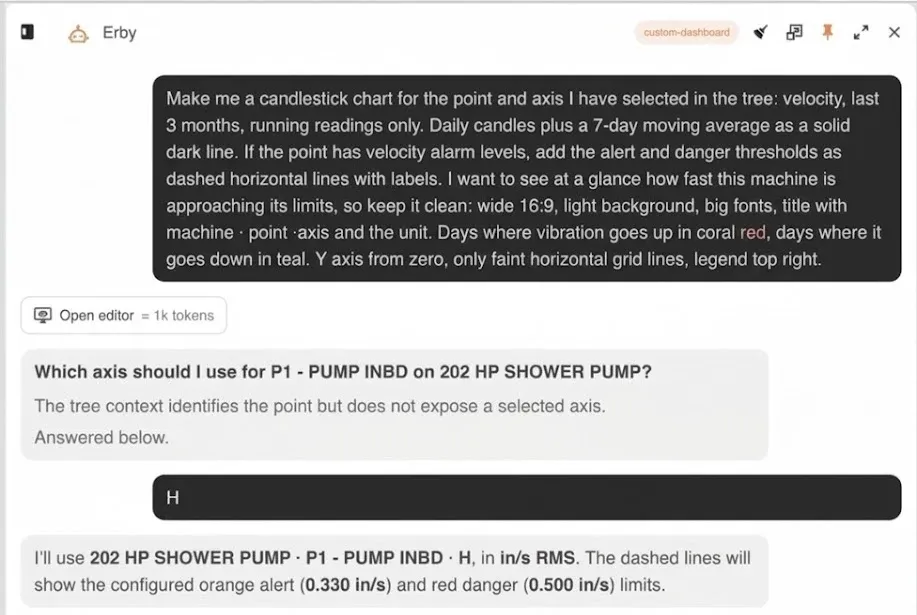
Erby asked a single question — which axis to use, because the tree identifies the point but not the axis — confirmed the two thresholds that point already had configured, 0.330 and 0.500 in/s, and drew.
Ken looked at the chart as an analyst: are the units right? Do the thresholds match? Does the trend make physical sense? He adjusted. He asked again. By the end of the afternoon he didn’t have a chart: he had a board of nine, acceleration, velocity and envelope across the three measurement axes, that follows the tree selection. Change the point and the chart changes with it. Not a line of code. Not a single intermediary.
What Ken brought, and the AI did not
What Ken did wasn’t magic, and it doesn’t require knowing how to program. It was four things any experienced analyst already has:
- He knew what he wanted to see. The idea of candles didn’t come from the AI: it came from years of looking at trends and knowing what a line with the day’s average hides.
- He asked for it precisely. Point, axis, period, type of readings, moving average, alarm levels. A good prompt looks a lot like a good work order.
- He reviewed with judgment. Units, thresholds, physical sense.
- He iterated until the tool showed exactly what he needed.
None of those steps can the AI take alone. All of them depend on the expert. That is what AI amplifies, and what it cannot replace.
Erby: the agent that removes the intermediaries for the expert
That is what Erby exists for. It is the artificial intelligence agent built into EI-Analytic™ and the Digivibe MX® suite: it lives in a button at the edge of any screen, knows what you have selected in the tree and which screen you have open, and works with your machines, your readings and your alarm levels, under your session and your permissions. It sees nothing you cannot see.
Let’s be honest: Erby already does a good share of what a vibration analyst did five years ago. And what impresses me most is how it diagnoses: with charts. You ask for the diagnosis of a pump and, before answering, it goes and looks. It requests the trend, compares two moments, checks the phase between axes. And when it answers, it doesn’t say “high vibration.” It says the energy rose at 630 to 700 Hz and at 1.1 to 1.3 kHz, and not at 1X or 2X: a bearing exciting a resonance, not unbalance and not misalignment. And it draws the proof itself, the spectrum from six weeks ago overlaid on today’s with the two new peaks marked. You can go to the spectrum and prove it wrong.
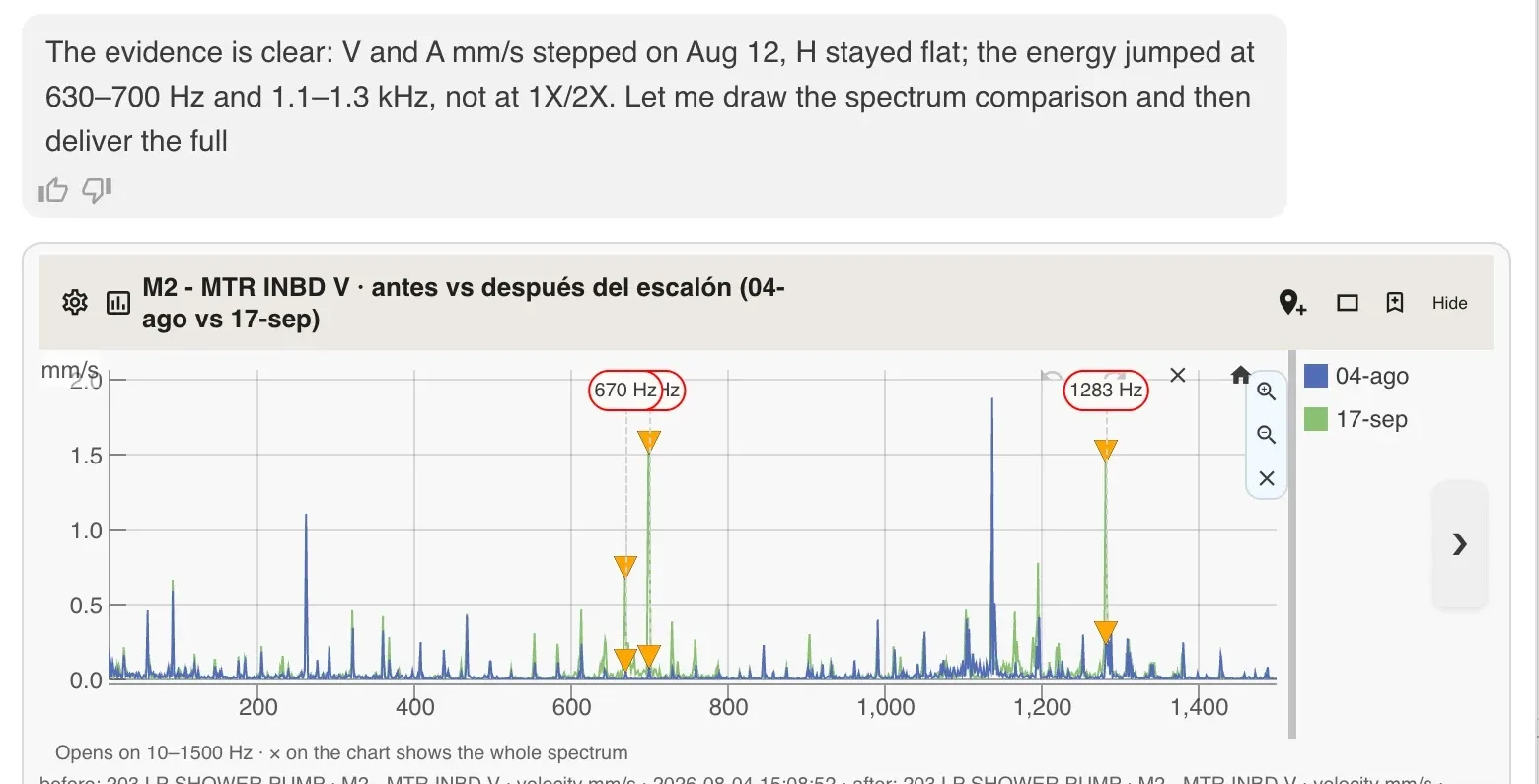
That, in seconds, across every machine in the plant. But that is not what blew my mind. What Ken did with it was. The analyst who five years ago spent the day collecting and plotting now spends the day deciding and creating.
The first thing that surprises anyone who tries it is the photo. You hand it a photo of the machine, tell it how the power reaches the fan, and review the 3D model it hands back, with the motor data and the four measurement points already placed.
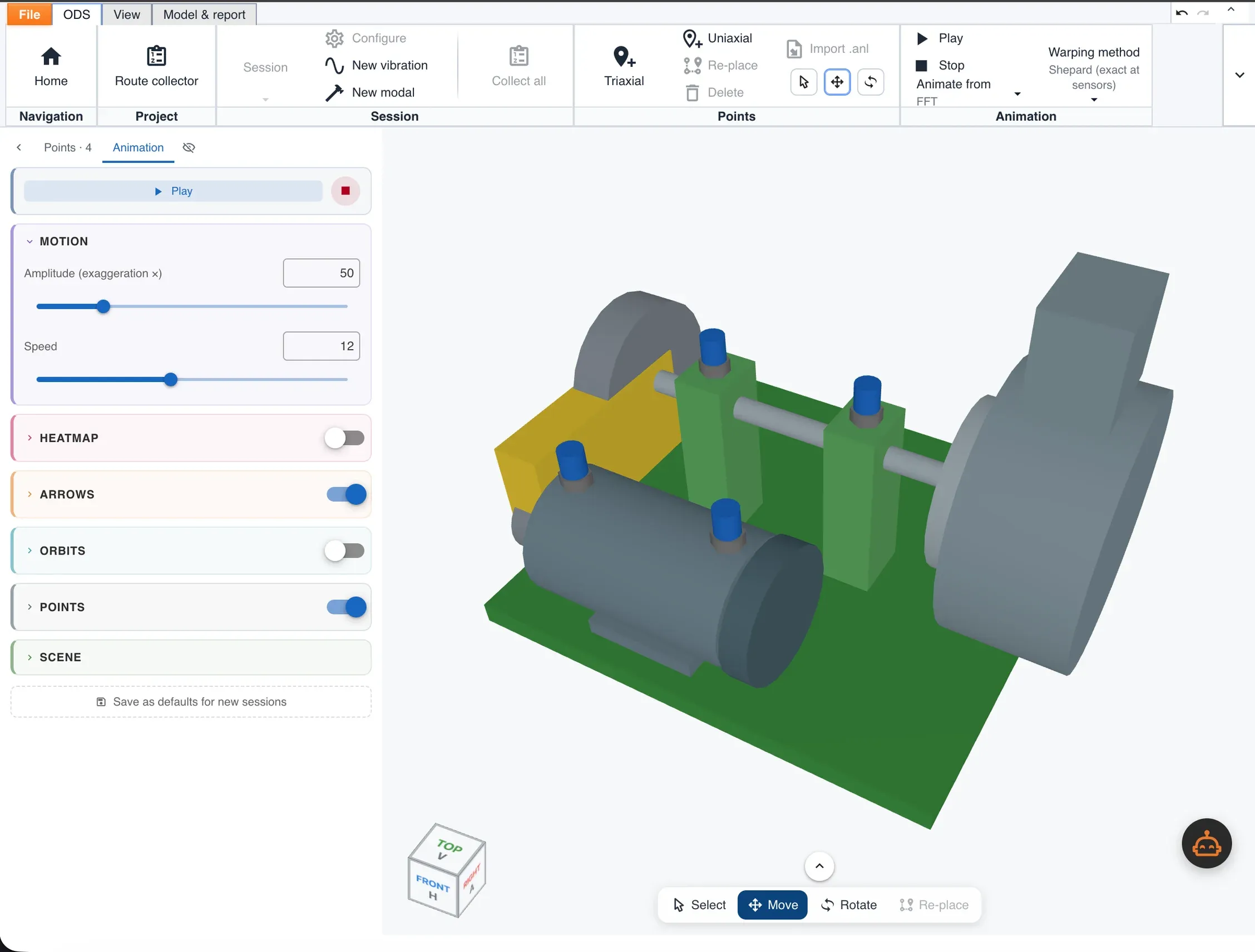
And what it already does today, starting with what the analyst does:
- You describe the board you want to see and receive it finished, with charts the software doesn’t have, like Ken’s candles, and you save it for the whole team.
- You ask for the shift briefing and it tells you what changed in the plant since the last time you asked and which machines are in bad shape; it reads your cases and prepares the new ones and the notes: you save.
- You ask for a diagnosis and the verdict includes the state of the sensor: whether it fell off, whether it is poorly mounted.
- You balance with it, with its one-, two- and three-plane calculators, and you use it from Dragon Vision® to find the model and adjust the shot.
- It learns you. It remembers your criteria and analysis preferences — always visible, always undoable — and organizes your conversations by project.
- And it never saves anything on its own. When it prepares a case, a note or a model, it opens the software’s window already filled in and you are the one who presses save.
How to try it. Erby is already available in EI-Analytic™: it is enabled per account — ask your Erbessd contact — and starts with a trial. It is priced as a service, per user, and every answer shows what it cost. The administrator of each database decides what the agent can see: by default, help with the software only; if authorized, engineering data without company or plant names, or everything.
Specialists have their place. And far beyond.
The candlestick chart is not the real story. The real story is who created it, and how little they needed to create it.
For years, an idea like that had to travel from an analyst’s head to an improvement request, and from there to a software team’s backlog. I know because that team is mine, and many good ideas never arrived. Today, whoever understands the machine shapes the tool the same afternoon the idea occurs to them.
The world is not running out of need for experts. It is becoming more demanding, more precise, far more creative and, in a sense, more beautiful: the knowledge of a whole working life no longer stays in a single head. It turns into tools that others can use.
Ken, thank you for reminding me.
Do you have an idea of how you would like to see your data? Try it with Erby in EI-Analytic™.
Further reading