Why Modern Commissioning Must Move Beyond Pass/Fail Measurements to Understand Machine Behavior
For decades, machinery commissioning has followed a familiar path:
- Install the equipment.
- Verify alignment and balance conditions
- Confirm operating parameters.
- Collect vibration measurements at normal operating conditions.
- Compare those measurements against accepted standards.
If everything falls within specification, the equipment is placed into service.
For many applications, this process has served industry well. It provides confidence that newly installed or overhauled equipment operates within acceptable limits before production begins.
But as rotating equipment has become more sophisticated – and the cost of unexpected downtime has continued to rise – an important question has emerged: Are we truly understanding how these machines behave, or are we simply verifying that they passed a test?
Those are not the same thing. Verification confirms that a machine met a specification at a specific moment in time. Understanding requires observing how the equipment behaves as operating conditions change, rotational speed varies, loads increase, temperatures stabilize, and dynamic forces interact throughout the machine and its supporting structure.
The distinction may seem subtle, but in fact it changes the entire purpose of commissioning.
Commissioning Has Traditionally Been Built Around Static Measurements
Most commissioning programs rely on measurements collected at specific operating conditions:
- Overall vibration levels are recorded.
- Spectra are reviewed.
- Critical measurement locations are compared against established acceptance criteria.
If those values remain within specification, the equipment is generally considered ready for operation.
There is nothing inherently wrong with this approach. International standards such as ISO, ANSI, and API have provided valuable guidance for evaluating vibration and for establishing acceptable operating limits across a wide range of equipment.
The challenge is that these measurements represent snapshots. They answer important questions:
- Is overall vibration acceptable?
- Are the shaft and bearing housing vibration levels within specification?
- Does the machine satisfy contractual acceptance requirements?
Those are worthwhile questions. They’re also the questions that commissioning has traditionally been expected to answer. But rotating equipment is not static – it is dynamic.
A machine continuously responds to changes in speed, load, temperature, lubrication conditions, structural flexibility, and process variables throughout startup, shutdown, and normal operation.
A single measurement accurately describes one moment. It cannot describe everything that happened before it, nor can it explain everything that may happen afterward.
Machines Don’t Operate in Snapshots
If the goal of commissioning is to understand machine behavior – not merely to verify that it meets a specification at specific operating parameters – then an obvious question follows: What information are we missing?
The answer isn’t necessarily more vibration data. It’s better observations, collected with sufficient context to understand machine behavior. Traditional vibration measurements remain essential for predictive maintenance and route-based monitoring. Acquiring high-quality measurements from individual locations enables analysts to identify developing faults efficiently and consistently.
Commissioning, however, presents a different challenge. Things can change in an instant.
Consider how a large compressor, steam turbine, or generator begins its operating cycle.
- The turbine generator starts and accelerates through several speed ranges.
- Rotor dynamics change.
- Shaft critical speeds may be crossed quickly or slowly, causing resonance.
- Structural natural frequencies may be excited and cause localized resonance.
- Bearing loads and oil film characteristics change.
- Thermal growth alters machine geometry almost immediately.
- Shaft and housing alignment changes.
- Lubrication regimes evolve.
- Process loads begin and may take time to stabilize.
The equipment isn’t simply running; it’s evolving as speed, load, temperature, and process conditions stabilize.
From a vibration perspective, these transient moments are often the most revealing: subsynchronous vibration may appear only during acceleration; resonance may occur briefly before disappearing; phase relationships may change dramatically as speed increases; structural response may continue evolving as operating conditions stabilize. By the time steady-state operating speed is reached and conventional vibration measurements are collected and evaluated for severity, many of those behaviors have already occurred – and disappeared. If no one was watching, they effectively never existed.
To understand that evolution, analysts must observe not only individual measurements, but also the relationships among synchronized measurements as operating conditions change.
Understanding the dynamic response requires knowing not only what happened but also when, where, and how it relates to every other measurement collected at the same instant.
Understanding Machine Behavior Requires Context
One of the greatest advances in modern condition monitoring hasn’t been the ability to collect more vibration data; it’s been the ability to preserve context.
Context explains when something happened, where it occurred, and, most importantly, how one measurement relates to another. Without context, vibration measurements are isolated data points. With context, they become a description of the equipment’s behavior.
This distinction becomes especially important during commissioning because many developing mechanical conditions reveal themselves only when measurements are synchronized across multiple locations and continuously evaluated as speed, load and temperature change.
Two bearings, for example, may each exhibit acceptable vibration levels. Viewed individually, neither measurement raises concern. Viewed together, their relative shaft position, vibration amplitude, and phase relationships may reveal shaft deflection, structural movement, or dynamic behavior that would be impossible to detect from isolated measurements alone.
Likewise, continuous waveforms collected during startup may reveal transient events that disappear entirely before steady-state operation is reached. The vibration levels themselves may never exceed alarm thresholds, yet the behavior they reveal could fundamentally change our understanding of the equipment.
That is the difference between measuring vibration and understanding dynamic machine behavior.
Why Simultaneous Measurements Matter
Historically, many vibration measurements have been collected sequentially:
- The technician places a sensor at one location.
- Collects data.
- Moves to the next point.
- Collects another measurement.
- Repeats until the machine survey is complete.
For routine route-based condition monitoring, this approach has served reliability programs exceptionally well.
Most issues with rotating equipment are not hidden because the necessary measurements cannot be made. They remain hidden because the relationships among those measurements are never observed. During steady-state route collection, that limitation is usually acceptable. During commissioning – when speed, load, temperature, and machine dynamics are continuously changing – it becomes far more significant.
Commissioning poses a different challenge. During startup, conditions can change in seconds:
- Rotor speed changes continuously
- Loads evolve
- Thermal growth progresses
- Fluid forces stabilize
- Phase relationships shift
When measurements are acquired one point at a time, those relationships become increasingly difficult to interpret because the machine is no longer operating under the same conditions.
Synchronized multi-channel acquisition has long provided this capability with specialized instrumentation. Today, the availability of powerful, portable, and economical systems has made this level of advanced dynamic testing practical and affordable for commissioning and troubleshooting projects. Multi-channel, synchronized data acquisition reveals timing, phase relationships, structural interactions, and dynamic machine behavior as they develop.
Rather than asking: “What was the vibration level?”
Experienced analysts ask a much more valuable question: “Why did the machine behave that way?”
Synchronized Multi-Channel Testing – Without the Cost and Complexity
Advances in machinery diagnostics rarely come from collecting more measurements. More often, they come from asking better questions. During the commissioning of a steam turbine-generator, the objective went beyond verifying acceptable vibration levels. The goal was to understand how the dynamic behavior changed throughout startup, synchronization, and loading.
Synchronized multi-channel measurements are not new. What has changed is the availability of powerful, portable, and economical instruments that make this level of advanced dynamic testing practical on projects where it previously may not have been justified. For this commissioning project, the ERBESSD INSTRUMENTS® DEFIANT™ provided synchronized multi-channel acquisition throughout startup, synchronization, and loading, enabling the 4X Diagnostics team to observe how the machine’s dynamic behavior evolved under changing conditions.
A Machine That Appeared Perfectly Healthy
During startup, overall vibration levels remained consistent with commissioning expectations, and there were no indications that would normally prevent proceeding to full-speed operation.
As the turbine accelerated through approximately 2600 RPM, synchronized measurements revealed the development of a subsynchronous vibration – a component of vibration on the turbine shaft occurring below running speed that continued to evolve as speed increased.
This wasn’t simply an increase in overall vibration amplitude; it was a change in dynamic behavior. Had measurements been taken only before or after this operating point, the event could easily have gone unnoticed.
Looking Beyond Overall Vibration
One of the most interesting observations from the commissioning data was what didn’t happen. Despite significant subsynchronous shaft vibration measured on the turbine shaft, bearing housing vibration remained relatively low, and the gearbox and generator showed no corresponding abnormal response. Evaluating only the housing measurements, or reviewing each measurement independently, would have provided an incomplete picture of the machine’s dynamic behavior.
Yet synchronized measurements told a different story. The rotor was clearly responding to something that isolated vibration values alone could not fully explain.
This illustrates an important principle in machinery diagnostics: significant dynamic behavior may be clearly visible in shaft-relative measurements yet remain minimal in bearing housing vibration and be absent from other parts of the machine train. That’s because alarm values are designed to identify severity, not explain behavior. Understanding why vibration exists often requires looking beyond magnitude and examining relationships among multiple synchronized measurement locations.
Continuous Observation Changes the Investigation
Because synchronized data were acquired continuously throughout the startup sequence, the analysts could review exactly how the vibration evolved as conditions changed. Rather than relying on isolated measurements, they could examine the entire operating event. Questions that would normally require educated assumptions could now be answered directly:
- When did the subsynchronous vibration first appear?
- How did its amplitude change with increasing speed?
- Did phase relationships remain consistent?
- Were all measurement locations responding equally, or was the behavior localized?
None of these questions can be answered by a single vibration measurement taken after reaching steady-state operation. These questions are fundamentally different from those addressed during traditional pass/fail commissioning. They concern dynamic machine behavior, and answering them dramatically improves confidence in the data analysis and recommendations.
The Most Important Test Hadn’t Happened Yet
One of the defining moments in the investigation occurred after the turbine reached operating speed, the generator was synchronized with the grid, and electrical load was applied, providing an opportunity to observe how the machine responded to a significant change in operating conditions.
Conventional thinking might suggest that applying a load would increase vibration. Instead, something unexpected happened. The instant a small electrical load was applied, the subsynchronous vibration collapsed. The machine’s dynamic response changed again.
That observation became one of the most valuable pieces of information gathered during the entire commissioning process.
Why? Because it demonstrated that the observed vibration behavior wasn’t simply a fixed characteristic of the equipment. It depended on operating conditions.
Without continuous, synchronized measurements, understanding that relationship would have been extraordinarily difficult.
The value wasn’t simply in collecting more vibration data. It was in understanding how the machine responded to changing conditions – and why.
Seeing Motion Instead of Numbers
In addition to evaluating vibration values independently, synchronized waveform measurements were used to generate Operational Deflection Shape (ODS) videos that visualized how the shafts and bearing housings responded as an integrated mechanical system. The resulting operating deflection shapes provided an additional layer of insight.
Instead of asking where the vibration occurred, we observed how the turbine, bearings, and supporting structure moved as an integrated mechanical system.
The distinction is significant. Individual measurements answer isolated questions.
ODS animations do not replace conventional vibration analysis; they complement it by helping analysts visualize relationships that are difficult to discern from vibration measurements alone. ODS answers system-level questions:
- What components are moving, and which are not?
- Which components vibrate together, and which move out of phase?
- What is driving the observed motion?
- How does machine behavior change during speed and load changes?
Those insights are extraordinarily difficult to obtain from sequential measurements alone, yet they often provide exactly the context engineers need to distinguish acceptable dynamic behavior from developing mechanical problems.
What This Commissioning Methodology Demonstrated
At first glance, this commissioning project appears to demonstrate the capabilities of a portable, synchronized, multi-channel vibration system. It certainly does. It shows that advanced dynamic testing can now be applied to commissioning projects without the traditional cost and complexity of permanently installed monitoring systems or specialized instrumentation.
The more important lesson is the commissioning methodology itself. Instead of asking whether vibration remained below an acceptance limit, we evaluated how the machine behaved during startup, speed changes, and loading. Instead of collecting isolated measurements, we evaluated relationships. Instead of documenting a passing test, we developed a much deeper understanding of the steam turbine generator.
Understanding machine behavior has always relied on observing relationships. Portable, synchronized acquisition makes those relationships easier to see and understand.
Historically, this level of testing was often reserved for the largest or most critical equipment because the instrumentation, setup time, and cost were difficult to justify. The DEFIANT™ has fundamentally changed that equation, enabling consultants and plant personnel to apply advanced dynamic testing techniques to a much broader range of commissioning and diagnostic investigations.
The objective of machinery diagnostics has never been to collect vibration data. It has always been about understanding what the machine is telling us.
The Future of Vibration Analysis Isn’t More Data – It’s Better Understanding
For decades, advances in condition monitoring have steadily expanded our ability to measure machine behavior. Higher sampling rates, more sensors, additional channels, greater storage capacity, and faster processing have all improved our diagnostic capabilities. Today, however, the next significant advance is not simply acquiring more measurements – it’s understanding the relationships among them. The most valuable insight in this case didn’t come from collecting more data. It came from collecting the right data – captured synchronously across the machine, observed continuously, and interpreted within the context of changing operating parameters.
That marks a fundamental shift in thinking. More data does not automatically lead to better decisions. Context does. Relationships do. Timing and synchronization do. Understanding the relationships among measurements does.
Modern vibration analysis isn’t moving toward more information. It’s moving toward a deeper understanding of dynamic machine behavior.
Portable Doesn’t Mean Compromised
Historically, vibration analysts often faced a difficult choice: If advanced synchronized measurements or continuous waveform acquisition were required, permanent online monitoring systems were typically the only practical solution.
That made sense. Permanent systems provide continuous protection, automated alarming, and long-term condition monitoring that portable instrumentation was never intended to replace. For many critical assets, they remain the right solution.
The challenge has always been flexibility. Not every machine requires permanent monitoring. Not every commissioning project justifies the cost, installation time, or infrastructure associated with a permanently installed system. Yet many of those same machines still deserve a deeper level of understanding during startup, acceptance testing, troubleshooting, or performance verification. Until recently, achieving that level of understanding often required a permanent monitoring system or specialized instrumentation that many projects could not justify. Portable synchronized multi-channel wired and wireless technology has fundamentally changed the conversation.
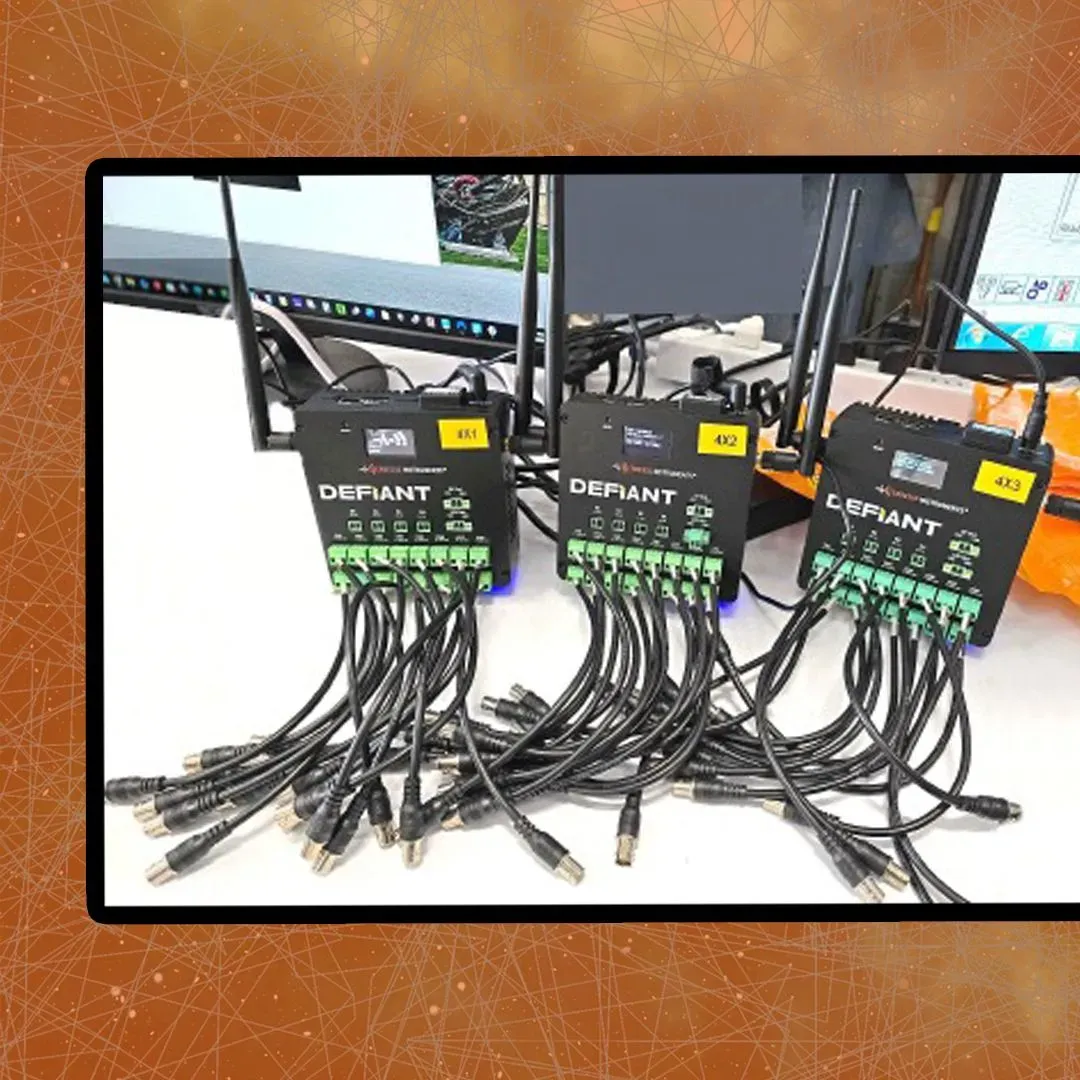
For the steam turbine generator project, the DEFIANT™ captured continuous synchronized multi-channel waveforms while simultaneously storing spectra, overall vibration levels, trends, phase relationships, and calculated analysis parameters from shaft probes, accelerometers, thrust probes, Keyphasors, microphones, and wireless accelerometers. Rather than relying on isolated measurements at selected operating conditions, the 4X Diagnostics team developed a synchronized dynamic record of the machine throughout startup, synchronization, loading, and shutdown. That information became both the basis for the immediate investigation and a valuable dynamic baseline for future reference.
The Erbessd DEFIANT™ has significantly improved the accessibility and economics of advanced field diagnostics. By dramatically reducing the cost and complexity of synchronized multi-channel testing, the DEFIANT™ has made advanced field diagnostics practical on projects where they were previously not economically justified. Its combination of synchronized multi-channel acquisition, broad sensor compatibility, integrated analysis software, portability, and affordability provides diagnostic capabilities previously available only through significantly more expensive systems or multiple specialized instruments.
The DEFIANT™’s innovation isn’t portability alone. It’s making sophisticated, synchronized, multi-channel diagnostics both portable and affordable without sacrificing analytical capability.
Commissioning Becomes the Beginning
The turbine generator investigation demonstrated something larger than the capabilities of a multi-channel instrument. It demonstrated that commissioning itself can serve a different purpose.
Traditionally, commissioning has been the final verification before equipment enters production: acquire measurements, confirm the specification was met, document the results, and move on.
Increasingly, leading reliability organizations view commissioning differently. They recognize it as the first opportunity to establish a dynamic baseline for the equipment’s entire life. That baseline extends beyond vibration severity. It includes:
- Dynamic response throughout startup and shutdown
- Phase relationships across the machine train
- Structural deformation under changing operating conditions
- Rotor behavior through critical speed regions
- Load-dependent vibration characteristics
- Operational Deflection Shape (ODS)
- Synchronized transient response from startup to shutdown
Instead of becoming another commissioning report that sits on a shelf, these measurements become a long-term reference for future reliability investigations.
Years later, when operating conditions change, or new vibration characteristics emerge, that original dynamic fingerprint serves as a reference that cannot be recreated after the fact.
Commissioning is no longer simply the end of an installation project. It’s the beginning of the equipment’s reliability history.
Final Thoughts
Every generation of reliability professionals inherits established practices. Some endure because they continue to provide value, while others persist simply because they’ve never been challenged.
Traditional commissioning has served industry well for many years. It verifies installation quality, confirms contractual requirements, and establishes confidence before production begins. None of that changes. What changes is what we expect commissioning to accomplish.
Instead of documenting only that a machine passed a test under normal operating parameters, modern commissioning can also document the equipment’s behavior across all operating conditions. That distinction has consequences far beyond startup.
Months or even years later, vibration analysts, engineers and operations are inevitably faced with difficult questions:
- Is this vibration new?
- Has the rotor always behaved this way?
- Is the structure responding differently than it did during commissioning?
- Did this characteristic exist from the beginning, or has something fundamentally changed?
Those questions become much easier to answer when commissioning captures machine behavior rather than simply machine condition.
The financial implications are equally important. Earlier identification of dynamic behavior reduces unnecessary troubleshooting. Dynamic baselines shorten future investigations. Temporarily deploying advanced instrumentation provides deeper engineering insight without requiring permanent monitoring on every asset. Most importantly, maintenance and operational decisions are based on understanding rather than assumption.
The future of commissioning will not be defined by acquiring more vibration data. It will be defined by acquiring the right data at the right time, with sufficient context to understand the machine’s complete behavior.
Because ultimately, the most valuable question we can ask during commissioning isn’t simply: “Did the machine pass?”
It’s the same question that inspired this discussion: “What are we not seeing?”
And once we’ve answered that, we can ask an even more important question: “Do we truly understand this machine’s dynamic behavior?”
The greatest value of modern commissioning is not simply proving that the equipment is ready for service, but understanding why it behaves the way it does when it is new or after an overhaul, before years of operation alter that behavior.